
A damp proof course (DPC, or damp course) is a waterproof layer built into a wall just above ground level to stop moisture from the ground rising up into the brick, stone and mortar. When it fails, is bridged, or was never there, ground moisture and salt climb the wall, and that is what causes salt damp, also called rising damp.
What a damp course looks like in an older home
In older South Australian homes the damp course is usually a thin layer in a mortar joint a few courses above the ground. Depending on when the house was built it may be slate, a bitumen-based layer, or another material of its era. Some early homes were built without one at all.
How a damp course fails
- Age. Older damp course materials break down, crack or become porous over time.
- Bridging. Garden beds, lawns, paths, paving or driveways built up above the damp course let moisture go around it. So can render or plaster carried down over it, and rubble built up in a wall cavity.
- Breaks at extensions. Where a house has been added to, the old and new damp courses do not always meet.
- Building movement on reactive soils, which can crack the layer.
- Never installed. Common in early homes.
How to check your own damp course
- Walk around the outside of the house and look for the damp course line in the mortar a few courses above the ground.
- Check that soil, garden beds, paths and paving are below it, with a clear gap.
- Look for render carried down over it, and for sub-floor vents that are blocked or buried.
- Inside, look for the signs of salt damp low on the walls: white powder, bubbling paint, soft plaster and crumbling mortar.
If garden beds or paving are the problem, lowering them is often the first step. How to prevent rising damp
How a damp course is replaced
Once a damp course has failed, it has to be reinstated to fix the cause of the damp. There are two ways to do it.
Silicone damp course injection
Holes are drilled along a mortar course near the base of the wall and filled with a silicone damp-proofing cream. It soaks into the mortar and cures into a moisture-repellent damp course inside the wall. It suits walls where the brick, stone and mortar are still sound. How injection works
Undersetting
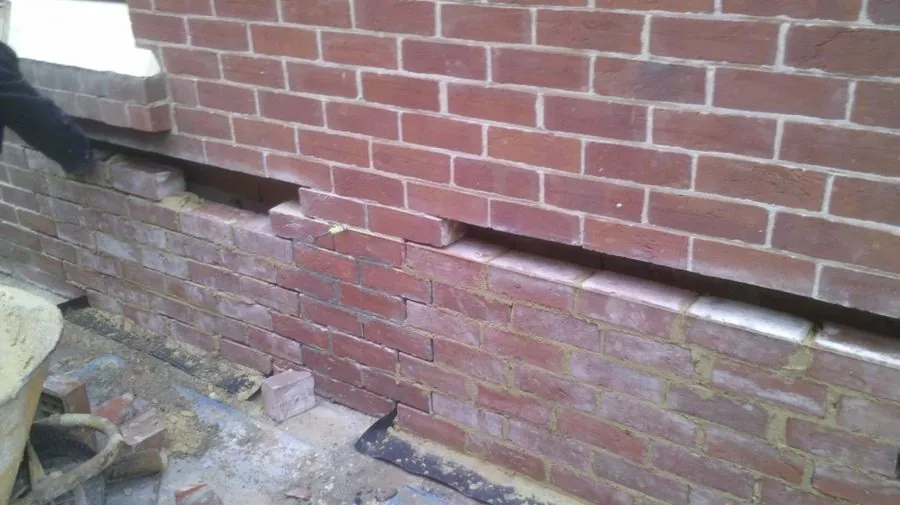
Short sections of the base of the wall are removed down to the footing and rebuilt on a new physical damp course with matching brick or stone, one section at a time so the wall stays supported. It suits walls where the bottom courses have crumbled. How undersetting works
Not sure if your damp course has failed?
Ring Barry on 0417 818 845 for a free on-site inspection. We will find the cause and tell you honestly what the wall needs.